(Note: you can click on photos for larger versions)
| "Teenage Years" |
(San Francisco, Tuesday, 15th January 2001, 8.47 a.m. )
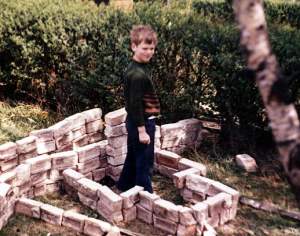
At the age of eleven, I left behind me the rough clothes of early childhood, put on my new school uniform, and walked with my brother Neil to my new school, Harton Comprehensive. I was a lanky, awkard, miserably shy, unusually self-conscious kid, with bony ankles sticking out of the bottom of flared black slacks that were an inch or two too short for my long legs. I unbuttoned the button of my pants and loosened my belt so that the bottom of pants would slide down to meet my shoes, and walked on slowly, reluctantly, uncomfortably behind my brother.
It's odd how very little I remember of my first days at school. It's likely that I've blanked it out, since it must have been such a shock to my system. The first year at Harton, we were in unstreamed classes, which meant that for the first time in years I was being schooled with other children that weren't in the top flight of academic achievement. There were some truly pathetic creatures in my class: Garvick, a malformed kid missing his two front teeth, with a shaggy mop of black hair, and a tendency to cry and wet his pants when spoken to by the teacher. And Martin Foster; a sullen, angry, malicious, ugly, powerful brute with a ruddy complexion, unfortunately sitting directly in front of me. One of his mildest habits was to pick his nose and flick it at people.
Phys.-Ed. was a nightmare for me. Every tuesday and thursday morning I'd wake up physically sick with nervousness, at the thought of it. I particularly hated cross-country, since we would only ever do it if there was too much snow on the fields to play football or rugby. We'd be forced to pound our way over the freezing hills around Cleadon, making a mad dash past the windmill to avoid the bulls.
But I feared nothing so much as swimming, because it would mean that there was nothing I could do to avoid being seen at length with my shirt off. I detested my skinny body with its long, thin arms, bony knobs on my collar bone, and ribs you could count openly. And since I'd almost drowned, once, in earlier years, when visiting Whitley Bay Swimming Pool with my cousins, I had a violent distaste even for the smell of chlorine.
Somehow, though, I must have gotten through that first year. Dawn began to break for me, after several years of what I remember as lonely unhappiness, when I entered my second year. My form teacher was Mr Hartis, a short, youthful, good-looking man who I'd once mistaken in the coridoor for a sixth-former, and been rather cheeky to. He seemed, by now, to have forgotten the incident, thankfully.
In front of me, there sat a tousled blond-haired boy named John Buglass, and to my left, a delicate-looking, pale-skinned boy with black curly hair, and huge eyes, Douglas Cromby. I didn't know it then, but these two boys would open a new world to me.
There was one anamoly in the face I presented to my schoolmates which spared me from being the complete wallflower I've probably described myself as. While I couldn't easily mingle with the other boys, and clammed up shyly whenever someone spoke to me, there'd developed enough of my Dad's sense of comedy in my own nature, that I sometimes couldn't help myself from speaking out loud to the teacher in a way that was intended to provoke a laugh. And it served me well, since, I think, without this, I'd have likely been as lonely in this school as I had in the previous. I noticed in particular that Douglas, to my side, would often flash me a glinting-eyed grin of shared amusement whenever I made one of my cracks.
Before long, we were spending our school-breaks together, talking politics. Douglas had a quality of gracefulness about him; his every movement was spare and economical, and his clothes conformed to him perfectly; shirt cuffs poking just half an inch from his blazer. He was from a very different class than I was, which in England, back then, was still important. I'd spent my childhood playing on the streets with the neighborhood kids - a rough, working-class bunch, and, to fit in, I'd adopted their uncouth dialect replete with vulgarities and oaths.
Douglas, on the other hand, lived in the posh middle-glass neighborhoods across from the Sunderland Road, and was an unusually snobbish Tory, who proudly looked down on the lower classes. What saved him from boorishness was his sense of fun. He loved to play with words, or interject the most inappropriate (for him) statement just for effect. For example, although he was most obviously a shade on the effeminate side - not at all agressive, whenever we played field hocky, and the opposition had the ball, he'd yell "Intercept!" and look at me with his mischevious grin.
Douglas didn't so much lower his standards to accept me into his circle, as I myself adapted my language and outlook to fit in with his. I quickly dropped my swear words, and harsh Geordie accent, and even started to affect distaste for "vermin of the earth", who should be lined up against a wall and shot. In other words, followers of the Labour Party, which, in Douglas' eyes, included everybody in the working classes.
Through Douglas, I met John Buglass, a long-term neighbor and friend of his, who was also my main competitor in our class for the top grades. I didn't immediately warm to John as much as to Douglas. John carried his intellectual superiority around with him wherever he was, and came across as too smart for his own good. As if that wasn't enough, he was also an excellent athlete, which gave him a bridge to class popularity that was unusual for someone who was also such a high achiever acadamically.
The first time I was invited over to Douglas' house was an eye-opener for me. I was frankly jealous of the comparison of the Crombies' suburban luxury with our own untidy, old furniture back home - our formica dining- table, which my parents still own to this day, and the large, faded oil painting in the living room with its attempt at an impressionistic take on a Paris street-scene. And there were two cars parked in the Crombie drive-way; every time I would come to call I'd be reminded of my own dependence on a long bus ride to get to Douglas' house.
On that first time over, we lay around in his bedroom talking about cars, ships and Tory politics, the three main areas of Douglas' interests. By then, we'd also discovered a shared passion for badminton, and we talked at length about the relative strengths of our games. As the Summer evening drew to twilight, and the light faded to grey in the bedroom, we planted the seeds of intimacy when we started to talk about our relationships with people at school. By nightfall, we must both have been conscious that a barrier had been broken, and that our friendship was to be important.
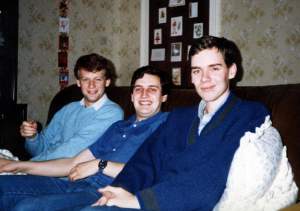
I don't have any early photos of the three of us - this is much later, John on the left, Douglas in the middle, me nearest the camera.
We walked around the block to John's house. If Douglas lived in suburban luxury, then John lived in a mansion, to my eyes at least - a big, solid, imposing old brick house, filled with heavy furniture resting on immaculate, silent carpets. John even had a half-size snooker table in his bedroom, which soon was to become our focus for many a weekend evening. Douglas and John had known each other for years, as I've mentioned, but I had a warm spot in my heart as we played snooker that first time, because I knew that I'd snatched Douglas to play a special role just with me.