(Note: you can click on photos for larger versions)
| "Lands End" |
(St Ives, Cornwall, Sunday, 16th July 2000, 8.03 p.m. )
I spent the morning on the edge of the World. After a refreshing night's sleep, I drove round the coastal roads to the very western end of England - Lands End. Perhaps that was just my overactive imagination, but the drive seemed unusually dramatic, as if to portent something unusual: absurdly narrow, winding roads, strange craggy hills whose tops looked as if some giant hand had sprinkled them with boulders, unusually persistent insects in the air, abandoned tin mines, and over it all a sphere of blue - the enormous sky and the circle of the sea.
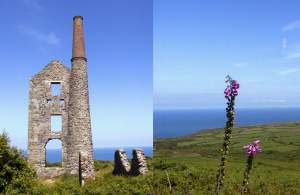
Sites from the drive to Lands End
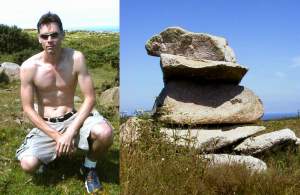
Weird rock piles
I pulled over in a tiny little hamlet called Morvah when I saw a sign for a gallery/cafe. Not expecting too much from either, I was surprised to find some very interesting works for sale inside (although the coffee was, indeed, very bad!) I tried to buy the piece I liked best - an assemblage of clay blocks in a black wooden frame, but I was five pounds short, and they didn't take credit-cards. The gallery owner did, however, give me the phone number of the artist, a retired police artist who lives in St Ives.
I had lunch in the self-advertised "last inn in England", but I should have known better. I passed at least two more on the final drive west to Lands End. At least it was probably the oldest of the three by a good two hundred years.
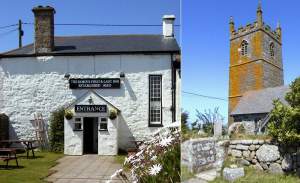
The supposed "last inn in England", and the adjacent church, covered in the characteristic orange moss.
Lands End, when I finally reached it, was very obvious. There's a big collection of white buildings near the cliff-edge - hotels, cafes, restaurants and tacky tourist attractions - in general, it's advisable to steer clear of any attraction that uses the word "grottoe" in its name. The rocks, though, are spectacular, as is the tall lighthouse on a couple of tiny rocky islets just off the coast.
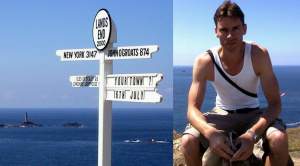
I'm sitting about as far west as you can get in this country. Next stop America!
I continued east along the coast towards Penzance. There was one absurdly pretty village I spent some time in, called Mousehole. A condensed ramble of old white stone cottages, tiny streets, and flowers, with a small bay protected by two massive stone piers. Oh, and tens of little galleries, some of them quite good. They really seem to take their art seriously here.
I drove through Penzance, but there didn't seem any particularly strong reason to stop, so I headed further up the coast to see Penzance Castle, which is situated high on a little island reachable by a causeway ... at low tide, which this wasn't. Two pounds to park, another few pounds for a boat ride, and five pounds odd to get in - it all didn't seem worth it. And anyway, I haven't exactly been deprived of castles on this trip.
By the way, I did take photos of both Mousehole and Penzance Castle, but I'm afraid they weren't good enough to publish. My Canon camera doesn't cope well with light conditions where there is a lot of contrast.
I returned to St Ives and finally managed to get a parking spot near the harbor, the area I hadn't explored as yet. I started off in the Barbara Hepworth Museum, which exhibits the works of the well-known sculptor in the same studio and gardens where she lived and worked for twenty years. I didn't know much about her, but I really liked her sculptures - beautiful, pleasing shapes and textures. They gave me the same sort of pleasure I'd gotten from choosing rocks and pebbles during my hikes in the Lake District.
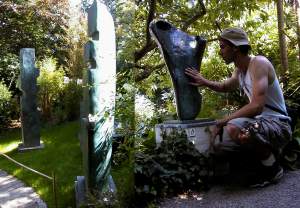
In the gardens at the Barbara Hepworth Museum - you're allowed to touch the works outside so don't worry, I'm not breaking any rules here :)
After visiting the museum, I called the number I'd been given for that artist, Richard Wilcox, whose work I'd liked in the little gallery in Morvah this morning. He was home, and lived nearby, so he asked me to stop by. He had several different versions of the piece I'd liked, and so I got to choose the one I liked the most. Not only that, it was five pounds cheaper than if I'd bought it at the gallery! A nice guy, and what a nice life he's made for himself after retirement: a small cottage near the town, but just enough above the harbor to get both peace, and a beautiful view from his studio at the back of his garden.
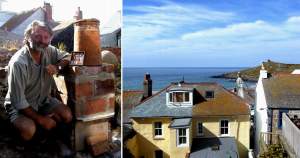
Richard Wilcox, and the little pice of his that I bought, next to the kiln in which the piece was baked. Right, the view from his studio. To the right of the view you can see the ancient chapel of St Nicholas on the hill top.
The harbor area is really very nice - again, the same winding, narrow streets filled with cottages and flowers, little cafes, galleries, beach shops. And the streets filled with people here either to see the museums and galleries, or dressed for the beach. There were even one or two cute boys amongst the hordes of pasty-skinned english holidaymakers :)
Having spotted the chapel of St Nicholas from Richard's studio, I walked along the beach front and climbed up the hill that leads to it. Close up, the "ancient" chapel doesn't actually look that old. It turns out that it was destroyed in 1904 by order of the War Office, for some reason, and later rebuilt, albeit using the original bricks. The hillside all around is great for lounging on and sunbathing on a gorgeous summer evening like this.
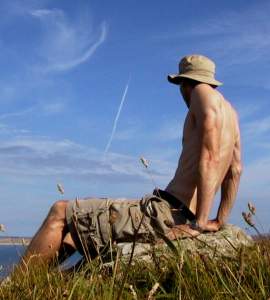
Enjoying the warmth on the hilltop near the chapel of St Nicholas.
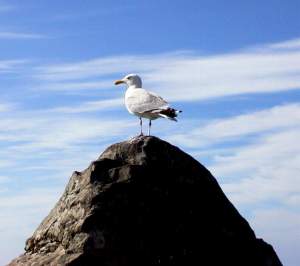
A seagull on a rock, a propos of nothing :)
I bought a cornish pasty for dinner, and sat down on a bench on the harbor side to eat it. Pasties are a cornish invention, although they've long since spread across england. But it's only a true pasty if it's made in Cornwall, and the cornish are going to court in the EU to try to stop other counties using the term "cornish pasty". They consist of a pocket of baked pastry filled with meat and potato, and they're meant to be eaten hot - maybe they're like "hot pockets" in the States? I don't know for sure though: neither I nor anybody I know has ever eaten a hot pocket :)
While I ate, the seagulls were getting a little bit too interested. But I wasn't prepared for what happened when I tossed them the hard bit of pastry at the end: a brief, furious squabble and then the losers setup a raucous squawk-squawk, staring at me accusingly, feathers all standing on end. It made such a racket that passers-by looked at me, with a knowing smile on their face - apparently you're not supposed to feed the seagull. Now I know why! Mind, the seagulls were discriminating in their appreciation of the pasty - it was excellent: I even bought a second one.
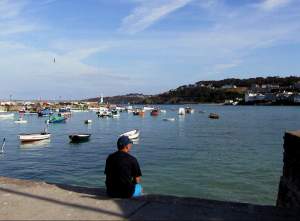
The view from the bench where I ate my pasty.