(Note: you can click on photos for larger versions)
| "Plymouth" |
(Plymouth, Monday, 17th July 2000, 9.14 p.m. )
I was out in the sparkling fresh morning by 7.30, taking a run along the coast road, hoping to find a way down to Portminster Beach. I certainly needed a run this morning, since my diet over the last few days has been particularly bad: yorkshire pudding and pasties, amongst other delights. I never did find the way down to the beach, but I did find a path along the cliffs, and down to the rocks. In the warm morning sun, it was nice to lie down on the soft, dew-wet grass and watch the fishing boats pass. Lovely peace, and the joy of a beautiful morning - you can't beat that.
As I mentioned the other day, there've been times on this trip where I've felt very lonely. I came here, amongst many other reasons, to help figure out some things in my life. Well, one of the things I've figured out is that it's not a good idea to spend two months almost entirely alone! During those times when I've felt that way, it's sometimes been difficult to see past the feeling of loneliness. But when I think to myself of all the many moments of joy and wonder - moments like this morning's run along the grassy cliff-tops, recorded for ever in my journal, I remember that not everything is black and white, and there's no gain without pain (and other cliches :)
When I got back to the hotel, I worked out in my room while watching the morning news program. The one piece of great news is that the sunny warm weather is going to continue for most of the week!
My hotel in St Ives was no great shakes: a great sea view, yes, but a lousy trickle of a shower, and traditional cooking. I've been trying to think why traditional english cooking (outside of the more modern chains and restaurants that have cropped up in the bigger towns in recent years) is so bad, and it can only be because of the insularity of working-class british culture, and hence a lack of exposure to how things can be a whole lot better than prawn-cocktail sandwiches filled with salad cream (ugh!)
On the whole, though, I've enjoyed St Ives - a good mix of scenery, character and the arts. Still, there's nothing like hitting the open road again, with new sights and scenery unfolding with each turn of the road.
I made great time towards Plymouth by following the major A roads for most of the way until the turn off to the fishing village of Polperro. You can't actually drive into Polperro: the village has set up a very large parking lot on the outskirts, and from there, it's a ten minute walk through increasingly picturesque, narrow streets lined with white 17th century whitewashed cottages, each cottage with its baskets of flowers. Right through the village runs a narrow, fast-running stream that's been channeled to run like a canal between the sides of the cottages. The stream suddenly emerges through a tunnel into the harbor inlet, empty of water at the current slack tide, but full of beached fishing boats. Along both sides of the inlet, above the massive, stone, barnacle-encrusted jettys, the cottages climb up the hill. It's truly the most delightful village I've ever seen - like a fantasy fishing town designed by Disney. I wonder how these fishing villages ended up being so pretty considering the hard-scrabble lives the early fishing families must have lived.
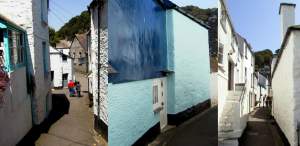
Cottages, cottages, cottages - Polperro
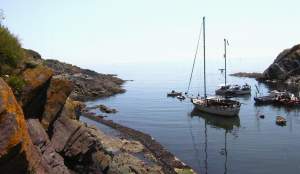
Outside of the protection of the jettys, yachts at anchor, floating on a calm sea that merges with the sky.
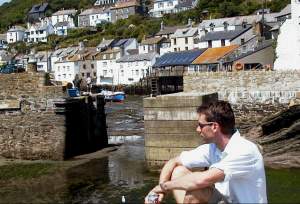
Eating a picnic-lunch on the walls above the harbor.
After lunch, on my way back to the parking lot, I stopped to buy some gifts: clotted-cream fudge (a cornish speciality), made here in Polperro. I indulged myself in a small chunk of banana fudge, which I ate over coffee. It was exquisitely sinful stuff, and it completely blew my diet for the day.
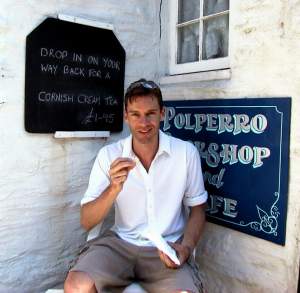
Eating my delicious banana fudge
From Polperro, it was only twenty miles or so along good roads to Plymouth. I parked near the Barbican, which is the old Elizabethan neighborhood. Plymouth is one of the most famous naval towns in Britain: Drake sailed from here to defeat the Spanish Armada, and again in 1577, in the Golden Hinde, to circumnavigate the World and claim California for Queen Elizabeth (we'd like to have it back, by the way). During the Napoleonic wars, the city, along with Portsmouth, was a key stronghold, both for the Navy and the Army.
I hadn't been out of the car long, when I decided to join a tour boat, about ready to pull out, offering tours of the naval yards. It took about an hour to motor all the way down to the far end of the bay and back, and for about half of that time, we were passing the naval dockyards (now mostly privatized). Plymouth has an enormous natural harbor, and its almost entirely lined with docks, and military buildings (some from the 17th century). Not many of the dockyards are now in use, but we nevertheless saw a whole series of warships and submarines in dock for repairs or supplies.

HMS Ocean, one of the biggest ships in the Royal Navy
After the tour, I looked around the Barbican, which was a bit of a disappointment - there are some Elizabethean buildings left, but the overall aspect of the area has been spoilt by too many modern, ugly blocks of flats and tourist pubs. I drove downtown in search of a good cup of coffee. But the shopping area, although it looked fairly cosmopolitan at first glance, was strangely shabby, and lacked most of the new food and beverage chains now common in towns across the country. I began to realise that Plymouth is really not a very prosperous town - obviously, the navy boys don't have a lot of spare cash to spend in the town, and the naval presence isn't enough to drive much of a tourist trade, since Plymouth seems to lack nice, sandy beaches. It's really just a massively overgrown dockyard town.
I finally checked into my hotel, but didn't linger long - I didn't even unpack. The late afternoon sun was still warm and delightful; moreover, my hotel turned out to be right off Plymouth Hoe, the big green area next to the Royal Citadel (a massive fort built in 1660, and still a military base). The Hoe looks right out into the port, and is a wonderful place to catch the sun, or to watch the passing ships (the navy keeps up-to-date notices on the information boards about which warships are coming and going each day). Its also where most of Plymouth's military monuments are located. Most famously, however, Plymouth Hoe is where Francis Drake played bowls just before setting off to defeat the Spanish Armada. There is still a bowling green on the Hoe, and I stopped into the cafe there to ask one of the tea ladies if it was the same bowling green. Apparently it's not: the original one is long gone, and there's nothing even to mark the spot. So much for history!

Monument to Plymouth's naval dead from the two World wars
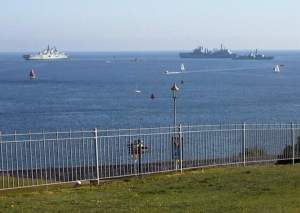
Massed naval ships in Plymouth Sound, as seen from the Hoe.
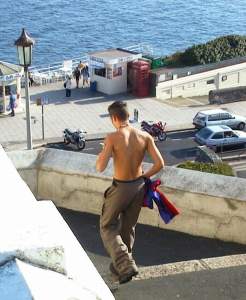
Wouldn't have minded basking with him :)
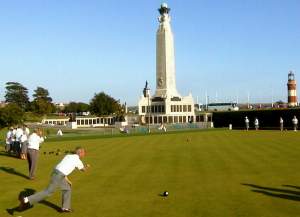
Bowls on Plymouth Hoe - but not the same bowling green Drake played on.
There was a military-band concert about to take place in the Citadel, and, since it was sold out and the weather was so fine, I decided to go back to my hotel, grab my picnic dinner and my laptop, and come back to the Hoe near the Citadel and find some shade in which to write my journal while hopefully hearing the military music come wafting over the lawns. At 8.00 prompt, fireworks went off with several very loud bangs, and then I heard the strains of our horrible national anthem. I waited to see what else would follow, and then, faintly, I heard the anthem to the movie "Superman". Oh well :)

Writing this journal, sitting on a bench in Plymouth Hoe